
AI tools don't answer "who's a good property manager" as one national question. They resolve it hyper-locally, market by market, based on signals like where your reviews say you work, how consistent your business information is in that specific area, and how much real, locally specific content exists about you there. Additionally, the answer isn’t set in stone, since large language models generate each response from probabilities even if the prompt is the exact same. A company can have strong AI visibility in the city it started in and be nearly invisible in a market it expanded into six months ago. The expansion itself may be going fine; the problem is that none of that signal depth was ever rebuilt in the new market. Showing up everywhere you serve means treating each market as its own dataset with its own score.
AI forms a separate opinion of you in every market
It's tempting to think of AI visibility as a single score: either you're the kind of company AI tools recommend, or you're not. In practice, an AI model answering “who manages rentals in this neighborhood” pulls from multiple signals tied to that specific neighborhood, and your company’s general reputation carries far less weight than you’d expect.
That means a property management company serving eight markets has up to eight separate AI visibility problems to solve. Doing well in the market you’ve served the longest tells you nothing about whether AI even knows you operate in the market you added last quarter.
What tells AI a market is yours
Reviews that specifically mention the city, neighborhood, or property in question. A five star rating with no location context does little here.
Business information that's identical across every listing and directory for that specific market: name, address, phone number, and service area, worded the same way everywhere.
Content written about that market specifically, with real rental trends and neighborhood detail. A template page with the city name swapped in won’t carry the same weight.
Third party mentions tied to that location specifically, a local directory, a community forum, or a locally relevant article.
Why expansion quietly breaks AI visibility
A new market effectively starts at zero, no matter how established the company already is elsewhere. The reviews, the consistent listings, and the locally specific content all have to be built again for that market. Company-wide reputation doesn't transfer automatically, because the AI model isn't simply evaluating the company as a whole. It's looking for whether there's real, local evidence for the exact question someone asked. The company’s overall standing plays a much smaller role.
This is the gap that shows up as a company scales: operationally capable in a new market, but functionally invisible there to anyone using AI to find a property manager.
The data behind why this is hyper-local
68% of local searches now trigger an AI Overview that pulls directly from review platforms (Whitespark, 2025).
Businesses are roughly 6.5 times more likely to get cited through a third party source, like a local directory or review site, than through their own website (Yext Research, 2025).
Local search intent sits at 46% of total search volume, with 43% of those local searches now surfacing an AI Overview directly rather than a traditional results page (digitalapplied.com, 2026).
None of these numbers describe a single, company-wide visibility score. They describe signals that get evaluated locally, which is exactly why a strong presence in one market doesn't quietly extend itself to the next one.
Results from an internal experiment: same prompt, 22 different companies named
Earlier this month, I led an AI learning lab for PMW staff. During part of the session, everyone entered the same exact prompt, “Tell me who is the best property manager in Salt Lake City, Utah,” into Claude or Gemini at the same time. Thirteen people shared the answers they received, and every response was different in both content and style. Three people didn’t get company names at all, with the AI model either offering vetting advice or asking clarifying questions. Of the remaining 10 responses, there were 22 companies mentioned, but only four people received a definitive “best” in the answer. No single property manager landed in each response, and the one that got the most mentions was never recommended as the outright top choice.
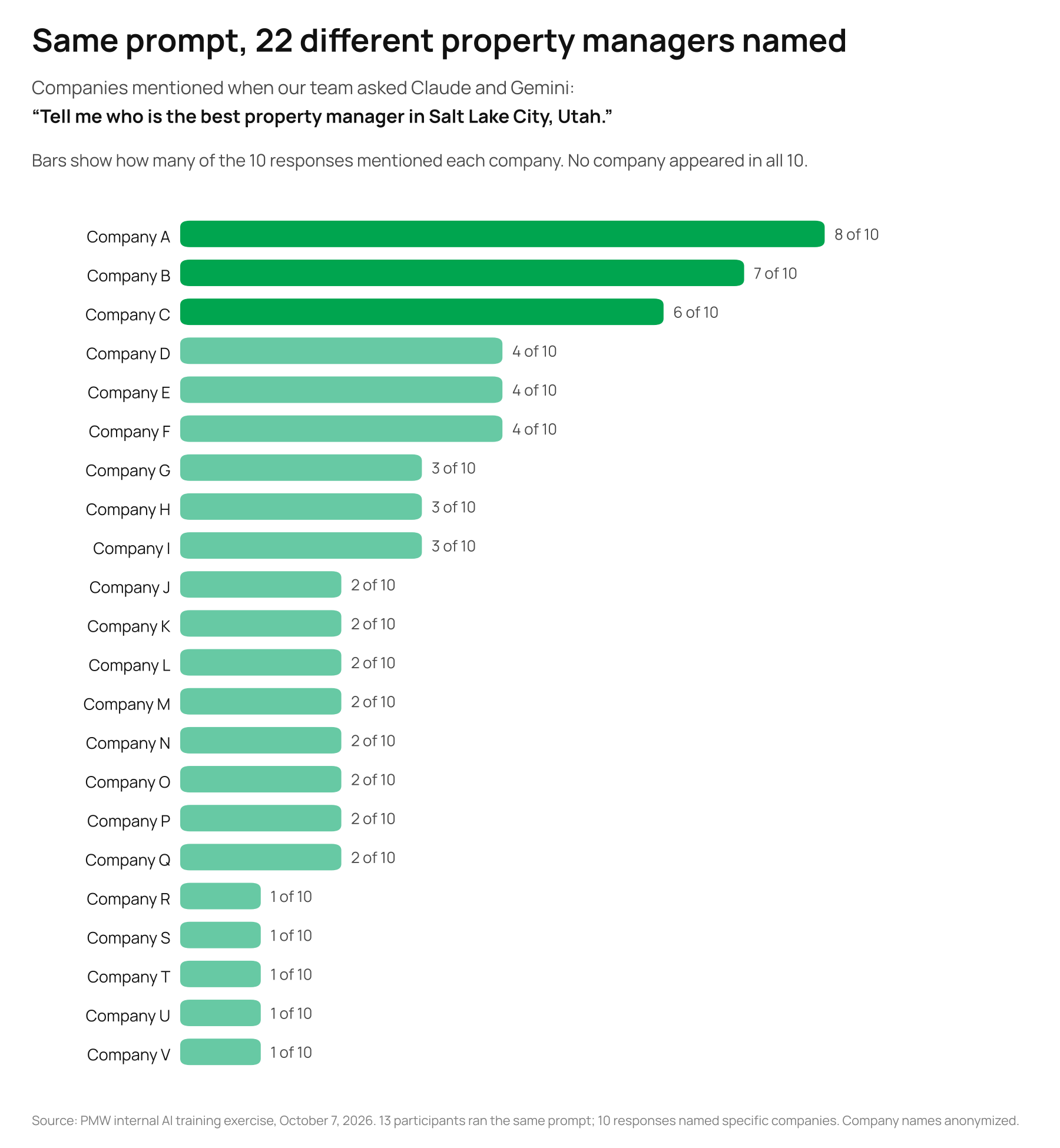
Even though no company received a mention in every answer, there was a commonality for the ones that showed up most often. All of them had a large number of local reviews and appeared across multiple third-party directories. This is just one example of how visibility in AI search is earned one market at a time and measured by how often you’re mentioned. If a single city can produce 22 different results for the same prompt, there’s no reason to expect that a company’s visibility in one market will match its visibility in another.
Treat each market like its own dataset instead of a slice of one big number
Property managers already know not to price a rental off a single national average when real, local comps exist. AI visibility deserves the same discipline. A single company-wide impression of "are we visible to AI?" hides where the real gaps are. The more useful question is which of your markets are AI visible, and which ones you’ve quietly assumed are covered because a different market is doing well.
The software side of this problem
Building AI visibility market by market is the data and content side of showing up everywhere you serve. There's a related but separate operational side: making sure your software can actually absorb the doors a new market produces at the same pace your marketing finds them. Rentvine Smartsites, powered by PMW, is built around exactly that pairing, so a new market's growth doesn't stall out on either side of the equation.
The bottom line
AI doesn't see your company as one entity with one reputation. It sees a series of local questions, each one needing its own evidence to answer confidently. A property management company that wants to show up everywhere it serves has to build that evidence market by market, treating each one as its own real, local dataset rather than assuming success in one place will quietly cover the rest.
FAQs
If we're already well known in our original market, doesn't that help us in a new one?
Not directly. AI evaluates local signals for the specific market someone is asking about. A strong reputation in one city doesn't automatically transfer to a market you've only recently entered.
What's the fastest way to build AI visibility in a new market?
Start with consistent, accurate business information for that specific location across all platforms (including your website, business profiles, and social platforms). Next, build real, locally specific content for the page and encourage reviews that mention the actual market by name.
Is this the same thing as ranking on Google in each market?
They’re related, but they aren’t identical. Traditional local ranking and AI visibility both reward consistent, locally specific signals, but AI tools are also pulling from third party mentions and review language in ways a Google ranking alone doesn't fully capture. Another difference here is that AI models are non-deterministic, meaning that you won’t get the same answer from the same prompt. This is why showing up in AI answers is the goal, and we don’t talk about “ranking” in AI.
How do we know which of our markets have an AI visibility gap?
Check each market individually over time rather than assuming one company-wide impression applies everywhere. Look at whether reviews, directory listings, and content actually reference that specific city or neighborhood, beyond just mentioning your brand.
Does this only matter for companies actively expanding?
It matters most visibly during expansion, but any company serving more than one market is managing several separate AI visibility profiles at once, whether or not it's actively growing into new ones.